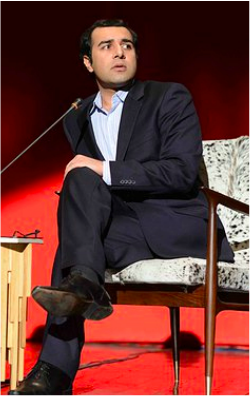
OMAR WARAICH
From 2016-2021, Omar Waraich worked at Amnesty International, most recently as Head of South Asia, covering a wide range of human rights issues - including the persecution of religious minorities, victims of terrorism, the rights of indigenous people, enforced disappearances, the death penalty, the protection of civilians in conflict, the rights of refugees, the protection of journalists and human rights defenders, crimes against humanity - across Afghanistan, Bangladesh, Maldives, Nepal, Pakistan and Sri Lanka.
From 2007-16, he covered Pakistan and other parts of South Asia for TIME Magazine and The Independent. He has written on political and democratic transitions, terrorist attacks, Islamist insurgencies, military offensives, Pakistan-U.S. relations, the blasphemy laws, religious minorities, culture, and press freedom. He covered many other events in Pakistan, including the lawyers' movement, the 2007 state of emergency, the assassination of Benazir Bhutto, the 2008 and 2013 elections, the epic 2010 floods, and the death of Osama bin Laden.
Omar has reported from South Asia, Europe, the Middle East, North Africa, and the South Pacific. He has also written for The New Yorker, The Atlantic, The Washington Post, Foreign Policy, The Guardian, The New Statesman, The New Zealand Herald, and The Economist Intelligence Unit. He has appeared on CNN, NPR, Sky News, BBC World News, BBC World Service, NBC, Bloomberg, and Al-Jazeera English.
In 2013, Omar was a reporting fellow, covering the persecution of religious minorities, with The International Reporting Project at SAIS-Johns Hopkins. In 2015, he won the SAJA award for "Outstanding editorial commentary on South Asia", and in 2022, he received the inaugural László Z. Bitó Award for Humanitarian Service from Bard College in recognition of his work to support "individuals threatened by injustice, violence, and tyranny."
Omar has a Master's in International Human Rights Law from the University of Oxford, where he was an Oxford Commonwealth Law Scholar, and a Master's in International Relations from the University of London.
Twitter: @OmarWaraich
E-mail: [email protected]
From 2007-16, he covered Pakistan and other parts of South Asia for TIME Magazine and The Independent. He has written on political and democratic transitions, terrorist attacks, Islamist insurgencies, military offensives, Pakistan-U.S. relations, the blasphemy laws, religious minorities, culture, and press freedom. He covered many other events in Pakistan, including the lawyers' movement, the 2007 state of emergency, the assassination of Benazir Bhutto, the 2008 and 2013 elections, the epic 2010 floods, and the death of Osama bin Laden.
Omar has reported from South Asia, Europe, the Middle East, North Africa, and the South Pacific. He has also written for The New Yorker, The Atlantic, The Washington Post, Foreign Policy, The Guardian, The New Statesman, The New Zealand Herald, and The Economist Intelligence Unit. He has appeared on CNN, NPR, Sky News, BBC World News, BBC World Service, NBC, Bloomberg, and Al-Jazeera English.
In 2013, Omar was a reporting fellow, covering the persecution of religious minorities, with The International Reporting Project at SAIS-Johns Hopkins. In 2015, he won the SAJA award for "Outstanding editorial commentary on South Asia", and in 2022, he received the inaugural László Z. Bitó Award for Humanitarian Service from Bard College in recognition of his work to support "individuals threatened by injustice, violence, and tyranny."
Omar has a Master's in International Human Rights Law from the University of Oxford, where he was an Oxford Commonwealth Law Scholar, and a Master's in International Relations from the University of London.
Twitter: @OmarWaraich
E-mail: [email protected]
|
|
|